We've gotten 9 inches of rain in February, which is close to our record of 12 inches. Maybe this means we'll get all the rain out of the way, and things will dry out enough to plant early. Now, that would be amazing.
The plan is to have a smaller garden with less plants to give individual varieties more room to grow. Diseases were terrible last year with the wet weather, hopefully giving plants ample room will help with that.
Cherry Tomato List
Black Cherry
Fat Cherry
Indigo Blueberry
Red Grape (F1)
Sungold (Hybrid)
Sweet Apperitiff
Tomato List
Black Brandywine
Black Zebra
Brandywine
Celebrity (Hybrid)
Cherokee Green
Chocolate Stripes
Chocolate Prince
Croustralee
Dark Brandywine
Delicious
Flame or Hillbilly
Goldie
Granny Cantrell's German Red
Green Zebra
Jaune De Flamme
Marianna's Peace
Peach Blow Sutton
Peron
Pink Berkley Tie-Dye
Super Marmande
Yellow Brandywine
Sweet Pepper List
Ajvarski
Boldog Hungarian
Corno Rosso
Corno di Toro
Corno di Toro Giallo
Figitelli Sicilia
Melrose
Red Marconi
Sweet Happy Yummy (F7)
Hot Pepper List
Aji Angelo
Aji Golden
Guajillo
Kimchi
Showing posts with label gardening. Show all posts
Showing posts with label gardening. Show all posts
February 11, 2019

December 1, 2011
Radish on Buttered Oat Bread
Cherry Belle, French Breakfast, and Icicle radishes.

Cherry Belle radish with a dash of salt on buttered oat bread.
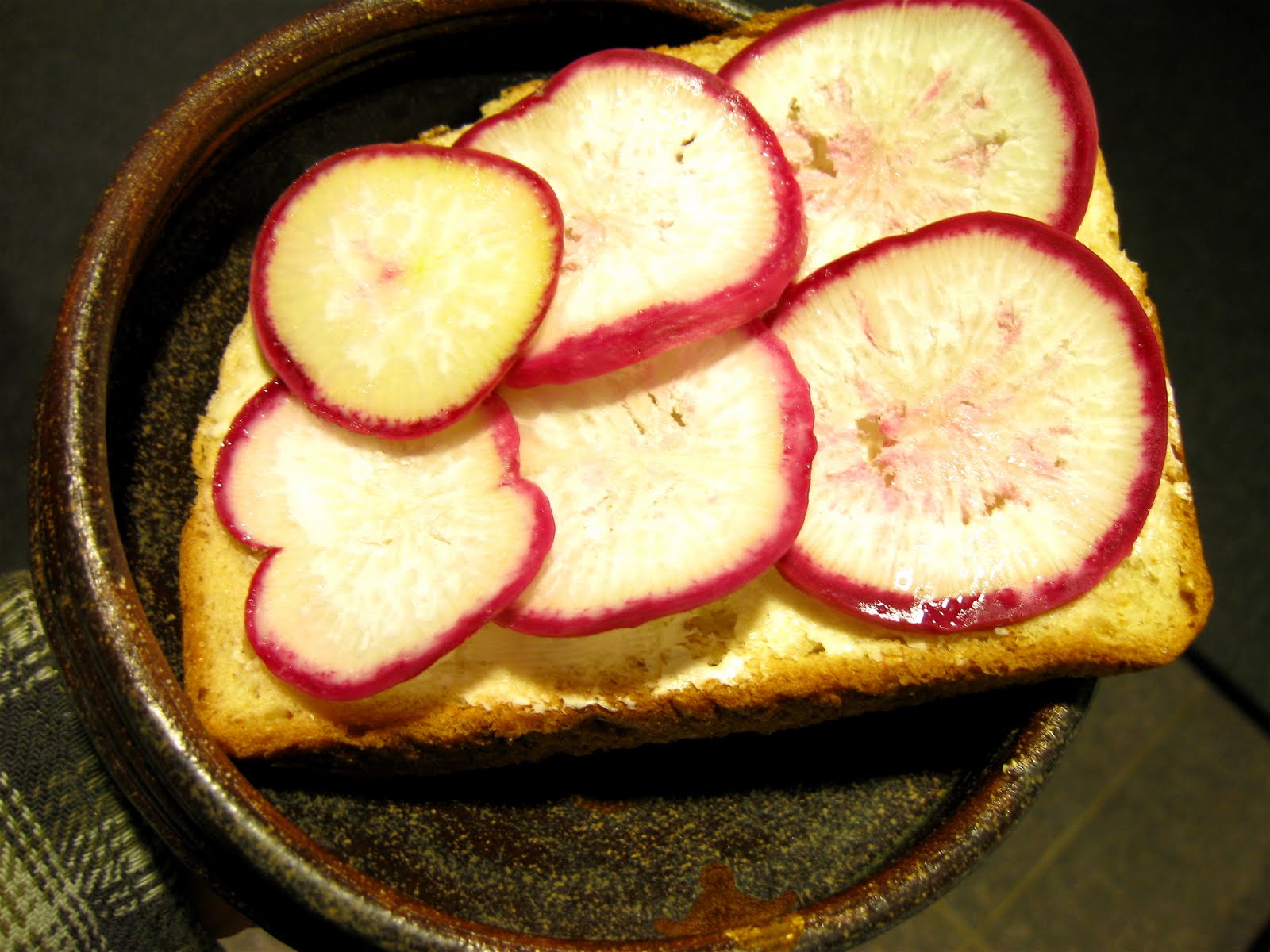
Remember those beautiful giant radishes picked from the garden in early November. Well I've been eating the delectable beasts with the kind of enthusiasm that borders on avarice. Never before had I enjoyed such a radish.
Prior to this I might have glanced at them in the grocer with mild interest those little red balls offered up in the springtime when the weather too quickly turns warm. Perhaps I even purchased a small bunch, quickly regretting the impulse purchase with the first bite from this weird little vegetable whose flavor was an odd mixture of heat and bitterness harking to consuming raw horseradish. Uck, who would eat such a thing. But now. Now. I am a convert, it is as though a moment of clarity has come over me. Grown in the fall with long cool nights and the mildest of days the radish is soft and tender with a crispness reminiscent of the delicate nature of young cucumber which has a drier more fleeting quality then their over-watered and overgrown compatriots. Served on buttered oat bread with the lightest sprinkling of salt, makes this vegetable. A revelation.
I am a bit sad and remorseful that all I have are a few self-sown radishes still in the garden. I will be mourning their absence when they are gone. Wishing I had taken the initiative to plant a giant bed of these lovely plants.
October 24, 2011
Broadcast Seeded Beets and Swiss Chard
The gentle Detroit Red beets.

The stout and tender Swiss chard.

Left: Two rows of sugar snap peas. Right: Double row of broad Windsor fava bean bed.

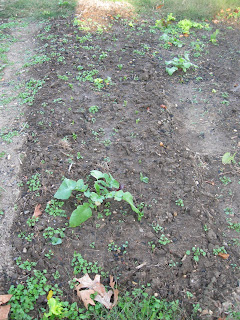
Left: Broadcast seeded Swiss chard and Beets. Right: Volunteer lettuce and radish.


Detroit Red beets and Swiss chard were broadcast seeded and then lightly raked over 2 weeks ago and are now sprouting beautifully. They still have 4 weeks to fill out and become established before the killing frost is forecasted for the end of November. The area the beets have sprouted is a bit thin so I'll probably fill it in with pre-sprouted Bloomsdale spinach seeds.
I'm currently pre-sprouting Bloomsdale spinach and Sugar Snap peas which seem to have problems germinating and breaking through heavy soil, it's a good way to check germination rates since these seeds are from 2009. Pre-sprouting is simple just wrap the seeds in moist papertowels and rinse with fresh water a couple of times a day until little rootlets appear and then gently plant them out singly in little holes. The seeds come up much quicker this way compared to just planting out seeds and watering the soil, germination rates seem to be higher with this method. This works especially well with eggplants and peppers which are notoriously finicky about sprouting at warm temperatures, just put the moist seeds in a warm place like on top of the refrigerator or near a heater.
Before this I have only gardened in the high desert of Idaho. A beautiful and wild landscape of high mountain pines, and desert valleys with sagebrush and dust storms blowing through. Rough country. Stark and uncompromising. Breeding rough private people who want of wide open vistas and to live the independent life. I miss the mountains. I miss the desert. But really, I miss the mountains the most.
September 4, 2011
Fall Vegetable Gardening
 This will be the first year of planting out a fall vegetable garden. Oooo, how fun. Luckily my area tends to stay frost free well into November, so let's cross our fingers that the vegetables will over-winter or reach maturity before the frost. The more winter hardy varieties I am planning to plant include Windsor Fava Bean, Fordhook Swiss Chard, Sugar Snap Peas, spinach, kale, collard, mustard, radish, Zefo Fino Fennel, kohlrabi, garland chrysanthemum, garlic chives, and bunching onions.
The less hardy varieties but yet should still make it are the beets, turnips, and lettuces. And a great variety of Asian greens including garland chrysanthemum a half hardy annual which can be harvested at 21 days and matures at 45 days that produces pretty flowers and readily self-seeds, the young herbaceous leaves are cooked lightly in soups, added at the very end during stir fries, or eaten raw as an herby green accompaniment.
Yu choy or edible rape is similar to kailaan (gai lan) or Chinese sprouting broccoli/kale in that the thick stems and sprouting flowers are eaten and can be cooked by lightly boiling the stems and then frying quickly with garlic and ginger make sure you don't burn the garlic and ginger or it'll be very bitter, or fried quickly and then chicken broth is added and cooked covered to lightly steam. Both yu choy and kailaan are wonderful vegetables served hot or cold with panfried fish and dipped in nuoc mam. Yum.
Then there's the Chinese cabbages like pak choy and tah tasi which are so good in soups in stir fries and only take to 3-4 weeks to mature.
My only set back to fall planting has been the rain. The day after the garden was rototilled it rained buckets. And I can't find the nylon trellis netting that the sugar snap peas will need to grow on. Grrr. I ended up ordering a new bag of netting from Amazon, even though I know somewhere in the shop lurks the other bag.
 Here's a beautiful chrysanthemum I picked up from the grocery store, the non-edible perennial variety. It will look pretty planted next to the back porch.
Subscribe to:
Posts (Atom)