Showing posts with label Swiss chard. Show all posts

October 17, 2012

The Garden Is Gone

Grey Seeded Simpson lettuce.
Giant bed of Simpson lettuce.
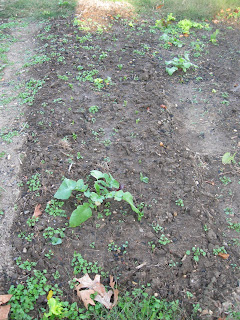
The Swiss chard is getting gigantic.

The bitter melon was mowed down and has grown back. The fruit is unlikely to mature before winter.
I had to leave town without a watering contingency plan during the hottest part of the summer so it was not a surprise to come home to a burned up garden. Sorry no pictures of the dead garden because it has since been mowed down. It is amazing how quickly the grasses have taken over, it is as though there was never a vegetable grown in that spot.

The summer drought has finally ended and the weekly rainfall has wrought an unusual sight. Lettuce starts abound cutting a chartreuse swath through the lawn, little bush bean plants, tomatoes, eggplant, and peppers are starting over again. They are terribly cute, but it is unlikely they will bare fruit even when frost comes late in our area. I have a terrible urge to plant a patch of winter radishes, since they are so juicy and mild when grown in the fall months.

July 13, 2012

Rain Showers in the Vegetable Garden

A nice heavy rain knocked down a couple of the Philippine Lady Finger okra plants

Stewart's Zeebest okra plant

Costoluto Genovese tomato almost ready to be plucked

The five thicker okra pods on the left belong to Philippine Lady Finger and the three on the right belong to Stewart's Zeebest. Usually I let the Stewart's pods grow to about 9 inches in length but these were picked small because the plants they were growing on are still tiny.

Swiss chard
We had a nice really heavy rain on Monday and the plants were just soaking it up. The okra pods has grown twice as fast since the downpour. A few of the Philippine Lady finger okra plants were knocked down but they are just fine after being righted.

The tomatoes are finally starting to look less brown and burned with many young fruits burgeoning and growing tips starting to swell again.

I haven't been very creative with the Swiss chard, this batch was sauteed in butter which I admit was a little bitter. The thick succulent leaves makes me want to wrap it around a meat filling. Hmmm.

June 23, 2012

Stewart's Zeebest and Philippine Lady Finger Okra Growing in the Garden

Stewart's Zeebest okra have nice bushy plants
Philippine Lady Finger okra short and yet desperate to produce offspring
She may be tall and skinny but Philippine Lady Finger can crank out that okra
Free range silver beet or Swiss chard, slightly wilted by the heat and bright sun
The two varieties of okra may both produce long smooth pods but the growth habits of the plants can not be so different. Stewart's Zeebest seem more robust with thicker stems and more branching to form  bushier plants. Philippine Lady Finger produces okra much sooner, when the plants are just 7 inches tall, they are so thin and spindly looking but still make beautiful long smooth pods.

The free range Swiss chard or silver beet gets a little wilted and depressed in the hot afternoon sun but perks right up when the temperatures cool. I've been pulling a few leaves now and then to add to stir fries. Otherwise, I'm not sure what to do with it.

May 29, 2012

Growing Bush Beans

The quiet, the tame, the ever fruitful bush bean.
The growing time, a bush bean story.
Silky and lustrous free range Swiss chard.
The quietly exultant chard.
The first planting of bush beans are filling in quickly with their first true leaves. I've been trying to space plantings every two weeks apart to extend the harvest since bush beans tend to bear in heavy flushes that last about two weeks, after which they need time to recover before bearing again. The beds are starting to fill up so bean seeds are going here and there in any bare space that is not filling in quickly. Summer is promising to shape up to be a dry one this year, so there's less fear of mildew and mold in regards to spacing plants in such close proximity. The bed that is purposed solely for the bush beans is twenty feet long with 6 rows of beans with half planted two weeks later than the other half.

Derby, Contender, Romano, Masai, and Blue Lake 156 were the bean varieties that were originally planted in the bean bed but a few rows didn't come up. It was probably Masai and Blue Lake 156 that didn't germinate because they were the oldest seed, so those rows were replanted with Kentucky Wonder which managed to come up beautifully.

The Swiss chard or silverbeet are ranging free, meaning they had grown back on their own in odd little spots. The chard in the top photo has been stepped on a few times because it's right dab in the middle of a walkway. It's still pretty and fun seeing it grow.

March 10, 2012

Surviving the Winter Blooming Windsor Broad Fava Bean, Lettuce, and Swiss Chard

Some of the pictures are clickable if you want to get a closer look at the plants that have survived the dark cold winter after sprouting in October.

Lettuce of the Self Sowed Variety and Swiss Chard and Wild Onions
Flowering Windsor Broad Fava Bean
The Windsor fava broad beans are full of blossoms even though nary a bean has yet to form. The plants are not very tall yet maybe ten inches (25.4 cm) but they should grow up to three to four feet tall (0.9 - 1.2 meters). Just a few had blackened tips from the winter frosts and some of the plants had stems that had bent and died in the wind storms but every single plant has lived through the long dark winter days, after being directly seeded into the garden mid-October.

The lettuces have formed beautiful rosettes, although the weeds are also huge and definitely competing with the lettuces. But the Swiss chard are tiny tiny tiny and the wild onions don't look as if they'll be getting very big this year. All the large lettuces were harvested December 2nd before the first hard frost, and the lettuce that are now in the garden were tiny self-sowed starts at the beginning of winter.

November 6, 2011

Detroit Beets and Swiss Chard

Left: the lovely beets trimmed in crimson. Right: the courageous Swiss Chard.
A carpet of Swiss chard seedlings.
The Detroit beets and Swiss chard were broadcast seeded about four weeks ago and they are just starting to get their true leaves. It seems like it took forever for the seeds to sprout, about 2 weeks for both the beets and the Swiss chard, and it seems to be taking forever for the plants to grow.

Broadcast seeding is an easy way to plant seeds that are small and can taking a little crowding. I just sprinkle the seeds over a patch of loose soil and then rake the soil lightly with the tines going less than an inch deep and making short strokes in a crossing X pattern that goes in opposite directions. Just try to get a somewhat even coverage over the whole bed. This technique seems to work well and usually there's just a few seeds that are left uncovered which I push into the soil.

Beets have a larger seed that is actually made up of a group of 3-5 seeds. I plant the beet seeds further apart then the recommended 2-3 inches by just putting down less seed when broadcasting so I don't have to thin the seedlings. Beets have an earthy warm flavor that is lovely in soups and wonderful as a pickle.

Swiss chard is a leafy green vegetable whose growing pattern is similar to bok choy with thick succulent stems and nice large green leaves, although Swiss chard has thinner stems and can withstand hot weather. Hopefully the plants will over winter without any protection.

October 24, 2011

Broadcast Seeded Beets and Swiss Chard

The gentle Detroit Red beets.
The stout and tender Swiss chard.
Left: Two rows of sugar snap peas. Right: Double row of broad Windsor fava bean bed.
Left: Broadcast seeded Swiss chard and Beets. Right: Volunteer lettuce and radish.
Detroit Red beets and Swiss chard were broadcast seeded and then lightly raked over 2 weeks ago and are now sprouting beautifully. They still have 4 weeks to fill out and become established before the killing frost is forecasted for the end of November. The area the beets have sprouted is a bit thin so I'll probably fill it in with pre-sprouted Bloomsdale spinach seeds.

I'm currently pre-sprouting Bloomsdale spinach and Sugar Snap peas which seem to have problems germinating and breaking through heavy soil, it's a good way to check germination rates since these seeds are from 2009. Pre-sprouting is simple just wrap the seeds in moist papertowels and rinse with fresh water a couple of times a day until little rootlets appear and then gently plant them out singly in little holes. The seeds come up much quicker this way compared to just planting out seeds and watering the soil, germination rates seem to be higher with this method. This works especially well with eggplants and peppers which are notoriously finicky about sprouting at warm temperatures, just put the moist seeds in a warm place like on top of the refrigerator or near a heater.

Before this I have only gardened in the high desert of Idaho. A beautiful and wild landscape of high mountain pines, and desert valleys with sagebrush and dust storms blowing through. Rough country. Stark and uncompromising. Breeding rough private people who want of wide open vistas and to live the independent life. I miss the mountains. I miss the desert. But really, I miss the mountains the most.