Showing posts with label vegetable garden. Show all posts

June 6, 2020

Happenings in the Garden

The vegetable garden got planted over Memorial weekend which I had to work, boo hiss. The cold wet spring had delayed planting of my seedlings, and the seeds that were directly sown mostly didn't germinate. But it was kind of nice having a long drawn out spring, even though it was a bit too rainy. But at last, summer is here to stay.

On Friday, May 22nd, my husband tilled the garden for a second time. He only tilled the top couple inches since it was still pretty wet lower than that, and I immediately started planting in earnest because it was supposed to rain from Monday on. It took 4 days to get most everything planted. It started raining while I was trying to finish seeding the last bed with bush beans.

These pictures were taken on May 31st and June 1st, when the plants had more than a week to settle in.
My friend gave me 12 tomato plants a month ago, mostly Oaxacan Jewel and Giant Aussie, but also a Black Krim and a couple Carbon. She had ended up with 36 Oaxacan Jewel plants when she thought they weren't germinating. We've all been there. I gave her a bunch of amaranth, zucchini, and pattypan squash plants as thanks.

Besides my friend's plants, this bed is also home to 3 Pink Brandywine tomato plants. It looks like all the plants have nearly doubled in size since being planted out a week ago. The plants at the end of the bed are basil and flowers that have been nibbled on by birds.
This bed is home to cherry tomatoes and smaller salad type tomatoes like Taxi and Juane Flamme. I started my tomato plants a month later than my friend's, but the vigorous cherries look like they might be catching up in size.

During planting I amended the tomato planting holes with crushed eggshells, spent coffee grounds, azomite rock dust, and Mykos mycorrhiza inoculant. Living in a humid environment I have a real problem with fungus in the garden. I'm hoping the mycorrhiza will help compete with the diseases below ground. I've also used Serenade, which utilizes a harmless bacillus and is considered an organic method to control bacterial and fungal infections in the garden.
The majority of the tomato plants I started took forever to germinate with the cold weather. They were just little sticks in the ground a week ago and even though they're still short, they are all forming blooms. My theory is we had such a chilly spring, then they were planted out on a day that reached 90 degree days (32 degree Celsius), so they thought they were dying and decided to perpetuate their species by bearing fruit.
Sungold blooms are already opening up.
Pink Brandywine with their potato leaves are blooming. They are very vigorous and productive in our climate.
This bed used to be home to 13 pepper plants, but the day after planting the birds topped all but two of the plants. Cilantro and different varieties of basil are residing here now with a nice stand of amaranth at the end of the bed.
Here's a pepper plant that was topped by a bird. It looks like it's trying to form new leaves at the joints of the cotyledon leaves.
Green amaranth at the end of the pepper & herb bed. Critters love to nibble on the amaranth leaves.
Droves of these bugs fly away when I water the amaranth. It's my first time growing it, and I've never seen this specific bug before.
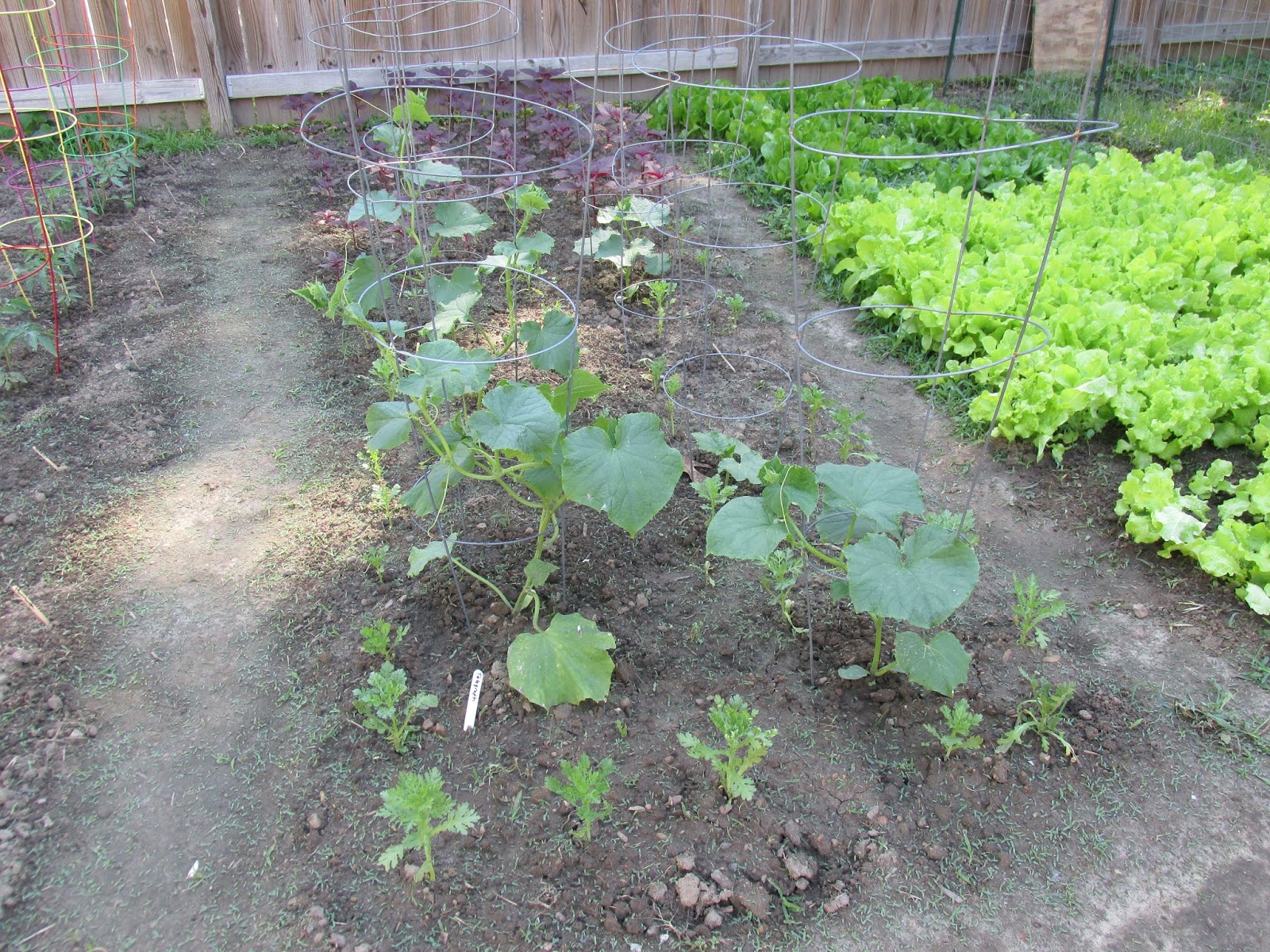
The Telegraph cucumber plants were in desperate need of being planted out. They immediately put out runners once in the ground. There's also edible chrysanthemum in the bed, along with red amaranth at the end.
The red amaranth is being eaten on by those same bugs besetting the green amaranth.
Squash bugs and vine borers usually decimate my squash and zucchini plants. So I plant tons of different varieties to compensate for the high insect pressure. In this bed starting at the far left are Tondo Di Piacenza a round zucchini, Elite zucchini, White Custard pattypan, and a single Rolet squash putting out runners in the back right.

You might notice the sweet potato laying on the ground at the bottom right. It was one of the two Purple sweet potatoes I used to start my slips. My son wanted to feed it to the squirrels, and wouldn't you know it, something did take it over the fence. The second sweet potato is now waiting for the squirrels to come get it.
Starting from the left Gentry summer squash, Butta zucchini, Fordhook zucchini, and Straight Neck squash. I just noticed that the growing tip on one of the Butta zucchini plants is gone, probably nipped out by birds.
There's an itty bitty round zucchini, if you look closely.
The bush beans are just finishing germinating. Normally I plant the rows much closer together, but with the greenhouse on the other side of the bed, I thought giving them room would make picking easier.
I tried a new way to form sweet potato slips. Instead of suspending the sweets so half was in water, I planted them in little tubs with potting soil. It ended up making very healthy slips with complex root systems. They say having lots of roots during planting means lots of small potatoes, hopefully that doesn't hold true.

There's also a row of seven Burgundy okra plants next to the fence. Their red stems are very pretty, but they've been taking a great deal of water to settle in.
This is one of the two beds that didn't get re-tilled. All those greens are from free range plants of likely mixed parentage. I just dug them up from around the garden when they were little and replanted them in this bed. There's also green onion ends from the grocery store that I rooted in water.

The mass of yellow flowers at the end of the bed are blooming Asian greens that I transplanted and am letting go to seed. They've been blooming for months, and once in awhile I clip and hang dry the seed pods.

I am very happy that we were able to plant the garden. The physical activity and doing things outdoors has been nice. We've chosen to not tell our young child about the pandemic. He's been asking about the parks, pools, and playgrounds. But since he can see the caution tape all around, we've told him that they're cleaning and fixing those areas. Usually my dad takes swimming lessons with him during the summer, but that is unlikely to happen.

In the tomato beds Tuscany melon and Ginkaku melon have just germinated. I'm hoping they'll provide some groundcover to shade out weeds, plus a few melons would be awesome. We actually love watermelon, but I've never been able to grow it here. I have a friend who does really well growing gigantic watermelons but she has raised beds.

April 10, 2020

Onward With The Garden, Better Late Than Never

So we decided to do a garden this year, even though last year was an unmitigated disaster. Last year I killed off my seedlings by over-fertilizing, then winds from a tornado blew apart the greenhouse, and then nothing grew because the weather was crazy.

Last week we decided to go full bore with planting because of the whole not going to the store because of social distancing thing, and then there's the possibility of inflation that could drive food prices up thing. So, on Tuesday, April 7th, my husband tilled and today, April 10th, the kiddo and I planted 9 out of 12 beds in the garden.

Tomatoes, peppers, and basil still haven't been started from seed yet, which isn't ideal but I've been too busy at work for it to impact me emotionally. Normally the lateness at starting the peppers and tomatoes would have me feeling a bit desperate.

My garden tends to be overplanted because of the high insect and wildlife pressure that exists, plants will die. It's a given.

This time around I did a lot of broadcast seeding for lettuces, greens, carrots, and bulb fennel. Then a hard-tined rake was used to lightly tamp the seeds down into the soil. I use this technique with good results for the tremendous amount of greens, radishes, and turnips I plant in the fall.

I'll probably still do some canning this year, but our main focus will actually be drying the vegetables. We've been eating a lot of internet purchased dried fruit, and my husband thought we could do the same with dried vegetables which can then be used in soups and casseroles.

June 14, 2018

The Weedy Garden in June

We planted the garden about a month ago, so I wanted to give a little tour of what's been going on.

It's been a fairly hot summer already with temperatures in the 90's since the end of May. Certain varieties are adversely affected by the unrelenting heat. A few tomato plants that did really well last year are half the size this year, and they're setting less fruit. Namely Cosmonaut Volkov, Peron, Coustralee, Black Krim, and Black Brandywine.
Caged tomato plants. The front row are all cherry tomatoes.
Sweet potato bed. The Purple on the left are spaced maybe 3 feet apart, whereas the unknown orange type (likely Beauregard) are spaced about 1.5 feet apart. Some of the slips I grew of the orange are ultra tiny so I figure they probably won't make it.
The kale are doing surprisingly well. They're in the shadiest part of the garden so that is likely helping. There's a Portuguese kale and a Nero de Toscana kale.
The Asian chives are still alive, although one accidently got weeded. But the shallots are all dead. It was during the time we got 4 inches of rain and then it immediately went to 98 degrees for a few days (36.7 Celsius). I think they actually got steamed to death.
The lemon basil is loving the heat. To the left of them is a row of ground cherries, being next to the lawn is probably hard on them. The ground cherries planted in the tomato beds are easily 2-3 times bigger.
Siam Queen basil is doing really well. They're surprisingly bushy without having to pinch off the main growing tip.
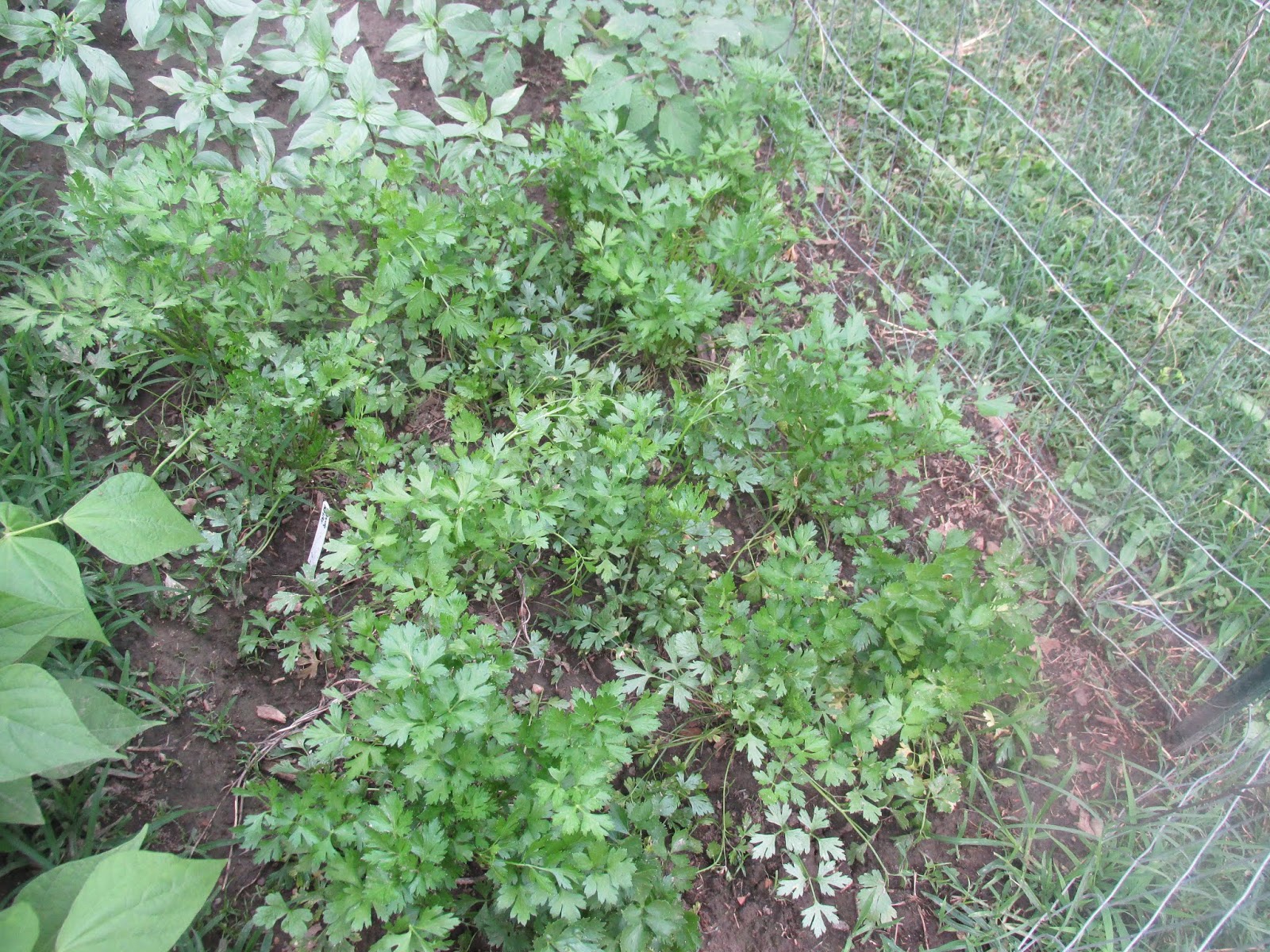
It's really nice to have parsley around to use, but at the bottom of the pic are a couple of leaf celery plants which I expected to get a lot taller. It would be a bummer if they stayed this small with tiny stringy stems.
I'm experimenting with caging Aunt Molly's and the unnamed ground cherry. They really want to flop on the ground, but I keep forcing them into the cage as the stems get long enough. 
Most of the cucumbers have reached the top of their cages and they're just starting to set fruit. There are few bees out and about, so I hand pollinate these along with melons.
And a very weedy patch of Morado corn, it's about waist high. A few of the plants were knocked down by heavy rain, hilling up soil around the stems seems to be helping with that.

Mostly sweet pepper patch with melons planted in the center. They've just started to bloom but peppers have a hard time setting fruit when nighttime temperatures are high.
I actually weeded the Buhl corn today and I managed not to pull or step on any of them. They seem to be forming quite a bit of tillers even when the plants are small.
Can you see the leeks amongst the weedy grass? I weeded half the onion patch a couple of weeks ago and half the onion plants died. It's made me nervous about weeding the leeks and the rest of the onions.
The bush beans are blooming. Hooray! Snap beans, here we come!
The potatoes in pots had yellowing leaves, so I trimmed them up and fed them. But something is still going on with this pot. They haven't bloomed or anything so I don't think they're close to being harvestable. This was just from a mix of red and yellow seed potatoes.
The Adirondack Blue potatoes are doing much better after being fed. No more yellowing leaves or anything.
The Blues are even blooming, hopefully they're actually making potatoes.
The plan is to weed the Morado corn tomorrow after work, and then weed the leeks and onions this weekend. I'll have to spend a lot of time with the leek patch so they don't get accidently get pulled along with the weeds.

I'm having a really hard time getting New Zealand spinach to germinate indoors. I might try using the area that used to house shallots as a seedling bed.

Thank goodness it rained a few days ago. I was hand watering sections of the garden in the morning before work and other parts after work. Which is part of the reason I'm so behind in weeding.

I'll be sharing pics of fruiting vegetables soon. I won't be getting big tomatoes at the end of June like last year, mid July more like.

June 18, 2017

A Tour of the Vegetable Garden in June

Our shadiest bed is home to Mizuna a leafy green, 3 eggplants ravaged by flea beetles, and kohlrabi. Mizuna and kohlrabi are normally spring vegetables but they're trooping along even with temperatures in the mid 90's (35 degree Celsius).
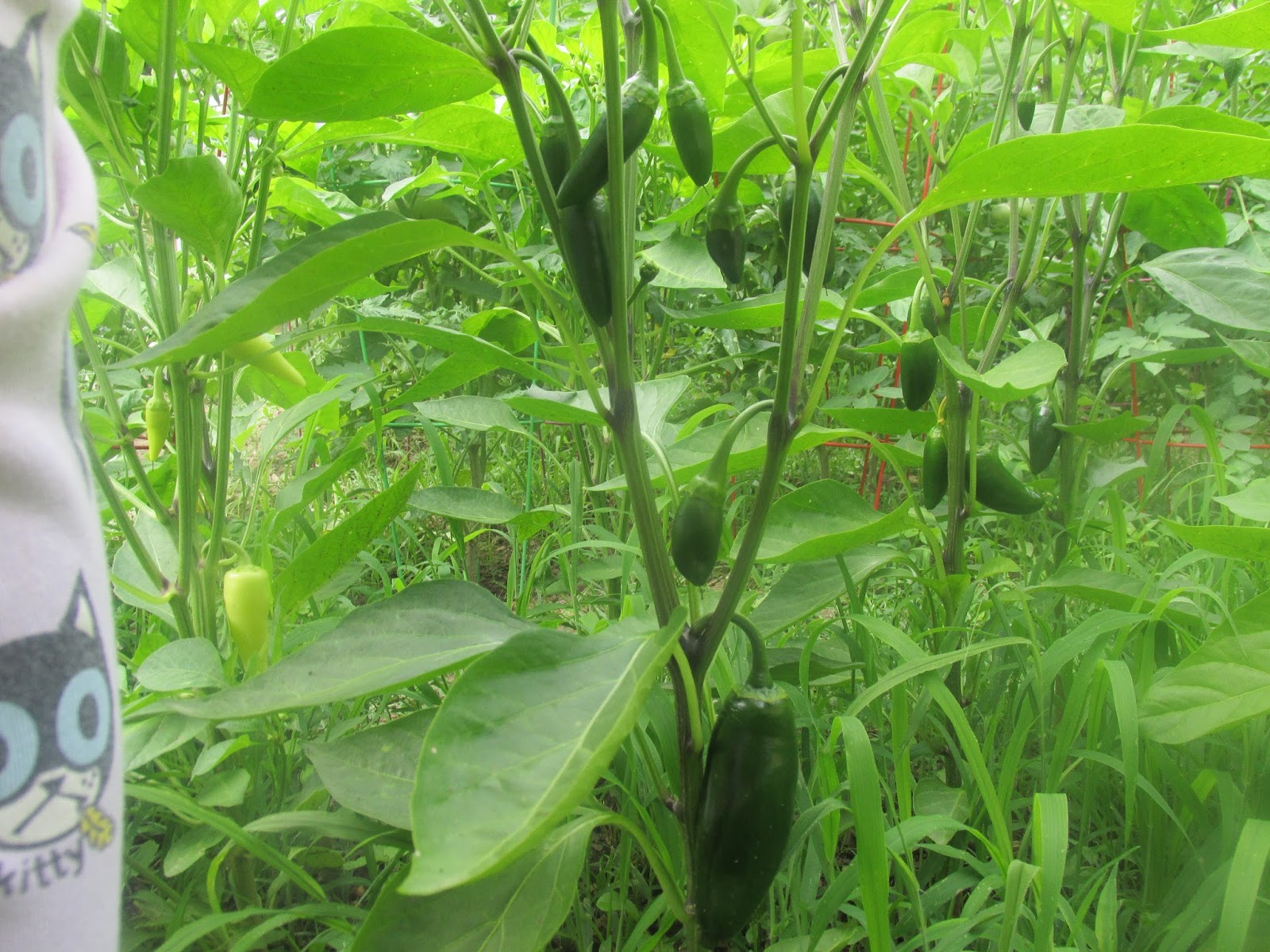
The hot pepper bed needs to be weeded badly, they're high on my list along with the leeks and fennel. The plants next to the wood fence are tall enough they're starting to get a lean to them, so they'll need to be staked soon. There's 42 pepper plants in this bed.

The peppers are a lot taller this year, even the jalapenos and lemon drop are getting to be tall plants. It's might be due to the weather because in hotter years they tend to be shorties, either that or maybe it's because they're spaced closer together. It makes me wonder if the yield will be affected since they're putting more energy into growth rather than fruit production.
And two bush bean beds have merged into one ginormous bed. You might not be able to tell, but there's a small fence around the bean bed made with 2 foot tall bamboo poles and string to keep them from flopping in the paths . At least the bush beans are starting to bloom, but I wonder how I'll be able to harvest them.

Snap beans are one of my favorite things from the garden. We sauté snap beans in olive oil with onion and long strips of carrot, add a little chicken stock and cook it down till the liquid is absorbed, so good. And of course, they're fantastic in stir fries.
And the fennel which is in another shadier bed is actually starting to bulb. I'm just as shocked as you are. They were so tiny and root bound and it's been so hot lately, but they're still managing to do their thing. There's some pole beans in the back of this bed, and yes that is a wall of Cosmonaut Volkov and Peron tomato plants to the right.
And the winter squash are starting to vine, there's a patch of them on either side of the greenhouse. It's been years since I've grown winter squash and I had forgotten just how massive they truly are. These were planted May 14th, to the left is Queensland Blue and to the right is Thai Rai Kow Tok. In the front are summer squash and zucchini which I use to block the winter squash from traveling into the rest of the garden.
Another winter squash bed with Yokohama to the left, Black Futsu to the right, and summer squash in front. I read a review on Black Futsu where someone harvested 37 squashes from a single plant that was growing in their tomato bed.

This is actually the shadier of the squash beds as some reviews of Yokohama and Black Futsu suggests they prefer a bit of shade.
The zucchini and summer squash bed is starting to encroach on the leeks. That's a bale of straw hiding beneath the leaves of the zucchini plants on the left.

I've planted lots of zucchini, patty pan, and summer squashes this year because squash bugs and squash vine borers usually kill or weaken most of the plants.
Against the 3 feet tall wire fence is planted a few Beck's Big Buck okra that were planted out as seedlings, the winter squash Queensland Blue is definitely crowding them a bit.
Here's a better picture of the row of okra, the three plants directly seeded on May 19th are still pretty small in comparison and above you can see a wilting vine of winter squash probably hit by a vine borers.
I'm still trying to keep the bottom of the tomato plants trimmed, but they are pretty unruly at this point. Various fungal disease are showing up in 3 of the tomato beds. I've tried spraying with a copper fungicide but will be trying Serenade, an organic control for fungus and bacteria.
I'm starting to suspect tomato speck is my main problem as the stems and fruit are infected as well. I've dug up one Manyel plant and heavily trimmed another of the same variety. It's possible we got some contaminated seeds and then the red tomato aphids are spreading the disease. I've never actually had aphid problems before in all my years in western Kentucky. Usually there are droves of ladybugs but there's only been a handful in the garden this year.
The tall tomato plants in back are supposed to be the determinate Celebrity (F1). They are considered a vigorous determinant or semi-determinant, but still they've grown way above the 54 inch cages. We've had the perfect spring and the plants are bigger than I've ever seen them.
This  Black Cherry tomato plant is taller than the 6 feet wooden fence. I've had to stake the cage with 3 bamboo poles.

I am mildly optimistic even with the diseases traipsing through the garden. It looks like it might be a banner year, which will hopefully be dubbed "The Year of the Tomato". I've taken a week off at the end of July with the hope of canning lots and lots of salsa.

The weather cooled off Saturday, so I actually got some weeding done for the leeks and peppers. Hopefully I can finish weeding the peppers, fennel, and winter squash beds before it rains Sunday afternoon.

And interestingly enough, something is parasitizing the aphids. I usually squash them with gloved fingers when I find them, but lately I've been finding their little tan mummified bodies with no young juicy ones in site.

June 16, 2017

Fruiting Vegetables in June

Butta (F1) zucchini. I've already picked a few un-pollinated fruits but it looks like the first male flowers are starting to show up. I grow lots of hybrids and open pollinated zucchini and summer squashes because of the high insect pressure in my garden. I've already squished a few squash bugs and it's early in the season.
Striata D'Italia zucchini. I can't wait to start eating them. First up will be a curry stir fry with soba noodles and tofu.
Lemon drop hot chili pepper. They didn't produce for me last year, but it was a blazing hot year with the heat hitting us by the end of May. We're only growing hot peppers this year for salsa.
The jalapenos were the first to set fruit and to the left you can see the very pale fruit of Santa Fe Grande. (And now you know I was out taking pictures at 5 am in my pajamas.)
Jalafuego (F1) hybrid doesn't actually seem as prolific as the regular Early jalapeno.
Hungarian Hot Wax is a thin walled pepper, and I think they're great in salsa. I was only able to get one plant to germinate this year.
Big Jim Numex is a Anaheim type pepper. They're already pretty big plants and they are setting fruit earlier than Joe E. Parker Numex.
 Ananas Noire is setting fruit later than previous years, but it's setting lots of them.
Paul Robeson produces purple black tomatoes. They're a lot larger this year with our milder spring, we've had hot springs where their fruit are small but early. In 2013 they were the first to ripen on July 2nd after planting the last week of April.
Brandywine is making some nice trusses of their very large tomatoes. They're still blooming profusely but I've picked off a few yellowing leaves that might be a sign of magnesium deficiency.
This is the first year Granny Cantrell's German Red has done well for us, they start out a pale green almost white with pretty fluted edges.
Celebrity (F1) hybrid is a monster of a plant this year. A semi-determinant they have large trusses of fruit. I've been growing this off and on for almost 20 years and find them dependable.
The first fruit on Cherokee Purple usually end up being a bit deformed, the plants are slow growing and fairly short but they can produce over a long season and do end up being big heavy plants in the end. We've had a drier than usual spring, but one big rain can ruin ripening fruit as they seem pretty sensitive to high water loads.
Pilcer Vesy is a large yellow fruited variety. I remember them being great on BLT sandwiches, if memory serves correctly.
And Pink Berkley Tie-Dye is a gorgeously striped and very tasty tomato. I do think they prefer it a bit hotter since they're not fruiting as prolifically as previous years. For an indeterminate, the plants are smaller but they produce early for a big tomato.

I'm trying to not get my hopes up because the last couple years have been terrible for tomatoes. Just a few bad storms can ruin a crop. And squirrels. But so far, it's looking pretty good.

There's still lingering affects of what I suspect is weed killer carried on the wind, especially on the Dark Brandywine, Black Brandywine, and Yellow Brandywine tomato varieties which are closer to that side of the garden. A coworker told me I might as well pull them up as they won't produce. But the new side-shoots seem to be more normal looking, so I'll leave them be.

I'll be posting a tour of the garden tomorrow. Bite my knuckle, but I haven't weeded as I should. Most of my extra time in the garden is spent trimming leaves that are infected with some kind of disease, perhaps fungal.