April 18, 2013

A Little About Germinating and Starting Seeds Indoors

I try to start peppers and eggplants so they are 12 weeks old by the time they're planted outside, but it can take a few weeks for their seeds to germinate. Tomatoes sprout out of the soil and grow fairly quickly so they are started 8 weeks before planting time.

The easiest way to start seeds indoors is by using a seed starting tray which can be a single or multi-celled tray with a light fluffy seed starting medium that allows the plants to easily sprout out of. Some gardeners use a tray without any subdivided cells and just plant lots of a single variety of vegetable or they plant different varieties in rows and label them, and then the seedlings are pricked out and deposited into larger individual containers.

Personally, I use a multi-celled tray. For germinating peppers and eggplants the seed tray is placed in a fairly warm area or where they will at least get consistently warm bottom heat, perhaps on top of the refrigerator or water-heater. The last 2 years I have been using pelletized coconut coir as a seed starting medium which is made from fibrous coconut husk and is light and fluffy, so makes for easy germination. The notable aspect of coconut coir is that it's a non-nutritive medium, meaning it will provide little nutrition to your growing plants so once sprouted the plants will need to be potted up in potting soil or compost in their own individual containers. The cotyledons or seed leaves will be the first set of leaves to emerge.
Tray of sprouting seedlings.
Then the newly potted up seedlings are placed in a sunny window or under lights. I try to get the lights as close to the plants as possible without touching them which will help them from getting too leggy as they try to reach for the lights. Some gardeners carefully run their hand across the top of the plants or have a weak fan running to promote stronger stems. Once the first set of true leaves start developing many people begin to feed the seedlings a watered down fish emulsion or some light liquid fertilizer on a weekly basis, I usually forget and feed the plants when they're a bit bigger.

Tomatoes, peppers, and eggplants under lights. 


A note on potting soil. Usually I repot the plants in potting soil containing compost, but some of the plants this year got repotted in a peat moss based medium. The ones in peat moss are not doing as well as the other plants, and most of their cotyledon leaves have turned brown and fallen off. Peat moss is notoriously acidic which makes me wonder if this affects the growth of the plants, plus I'm not sure how nutritious that sort of soil medium is.
Kellogg's Breakfast tomato in peat moss based soil medium.
The warm weather plants like tomatoes, peppers, and eggplants can start being hardened off outside when the daytime temperatures reach the 60's (16 Celsius). Let the young seedlings get a few hours of outdoor sunlight each day in a warm sheltered spot, it's best for the first couple days to be partly cloudy so the plants don't get traumatized and perhaps suffer leaf burn from the strong sunlight.

Once the last frost date has passed and the nighttime temperatures are consistently in the 50's (10 Celsius), the seedlings can be planted into the soil in the prepared garden area. I try to rototill the area for the garden a week before planting time, which will give the sun a chance to warm up the newly tilled soil. Hopefully by planting time the daytime temps are in the 70's (21 Celsius).
Moneymaker tomato getting some sunshine.
Bangladeshi Long eggplant you can see the difference between the cotyledon seed leaves and true leaves.

April 15, 2013

True Leaves Forming on the Tomatoes, Peppers, and Eggplants

Pink Brandywine tomato a potato leaf variety
Break O Day tomato with its finely cut true leaves.
Applegreen eggplant just starting to form its first spoon shaped true leaves.
Ma-Zu Purple eggplant with delicate purple veins. The downy leaves of eggplants are just adorable.
Jalapeno hot chili pepper
Seed tray planted with bulb fennel, kohlrabi, lettuce, chinese cabbage, chinese kale, and yu choy flowering broccoli.
The delicately green cotyledon seed leaves of the yu choy.
The tomato plants are finally sizing up and will be planted permanently out in the garden within 3 weeks, weather permitting. I love seeing the differences in the leaves depending on the variety. Looks like Pruden's Purple and Pink Brandywine are the only potato leaf types.

The eggplants and peppers are finally starting to form their first set of true leaves. They are a month or two behind because I got such a late start planting the seeds. I will probably wait a week after planting the tomatoes outside before planting out the peppers and eggplants. Eggplants especially prefer soil temperatures to be above 50 degrees at night (10 Celsius), otherwise it could slow down their growth. And to withstand flea beetle infestations, eggplants need to get big as fast as possible.

Some fast growing cool weather type plants were seeded in the starting tray 4 days ago. Most of the lettuces, kohlrabi, cabbage, kale, yu choy, and bulb fennel have already sprouted in that short amount of time. Woo hoo!

Now my husband just needs to get the soil tilled and I can start putting things in the ground.

April 6, 2013

Hardening Off Tomatoes, Peppers and Eggplants

It's 70 degrees outside! (21 Celsius) Such a gorgeously warm day with just enough cloud cover, the perfect day to set the plants outside for some real sunlight.

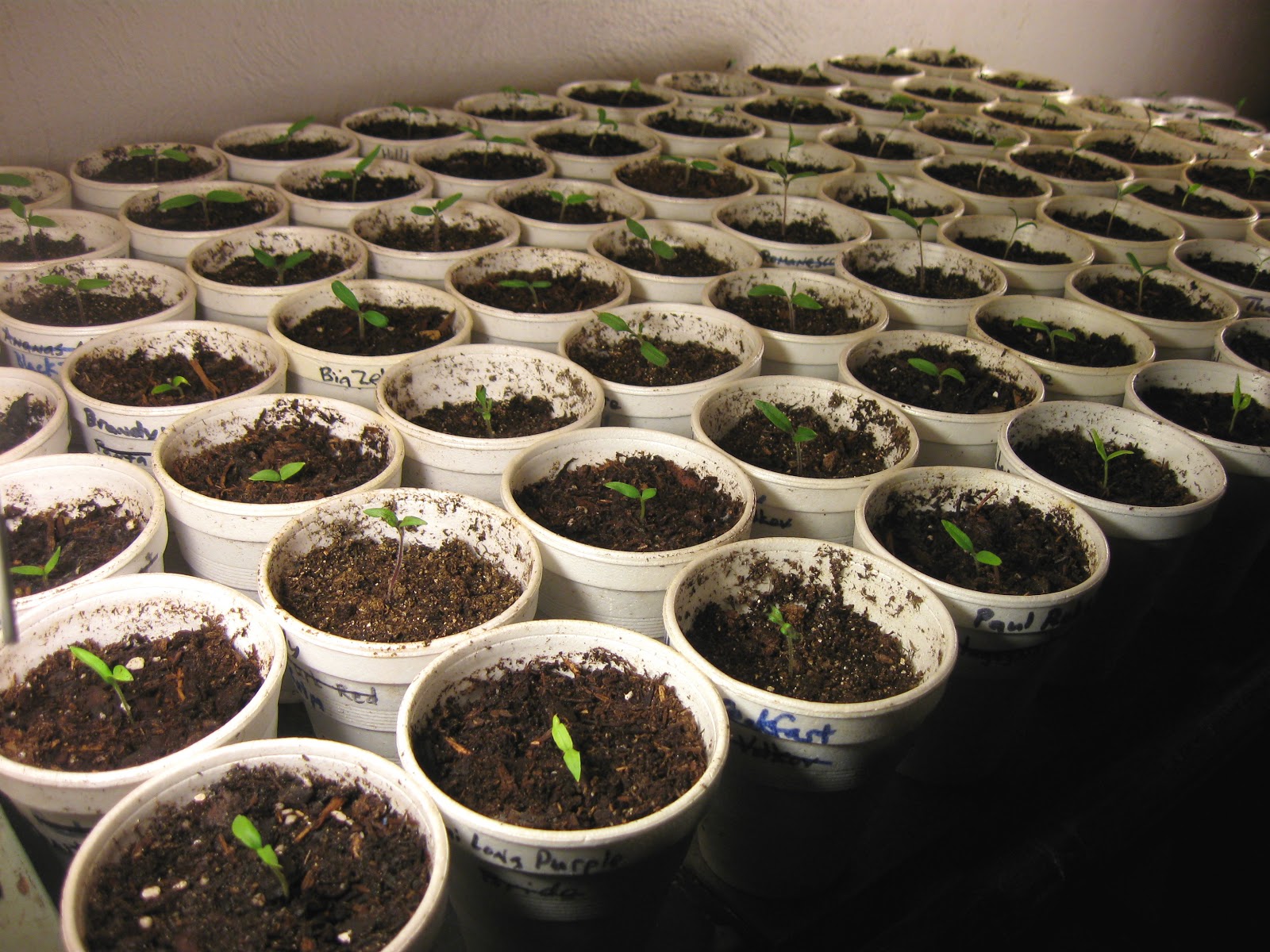
I finally pricked the last of the peppers out of the coconut coir starting medium and put them into their individual styrofoam cups. The granulated coconut coir I use is a light and fluffy starting medium, very easy for the plants to sprout out of. But it is a non-nutritive material made from coconut husk fibers which provides very little nutrition to the growing plants, so I go ahead and prick out the seedlings once they sprout and replant them.

There were enough trays to set a hundred plants outside to enjoy the afternoon sun, a mixture of tomatoes, peppers and eggplants. That left only 35 of the biggest tomato plants inside still under lights.

There's enough Brandywine tomatoes for me to experiment with different support techniques which will give me a good idea of production effects while keeping the variety of tomato constant. The 3 support systems will by my husband's interpretation of the Florida weave, staking and pruning of suckers to one leader, and caging tomatoes with either bamboo and twine or wire fencing.

The cold winter we had this year really did a number on the insect population. I saw only two gnats and a single bee while outside today. Hopefully it won't be too hot this year. High heat sterilizes the pollen in peppers and eggplants, so fruit rarely set during the height of summer.

April 4, 2013

112 Tomato, Eggplant and Pepper Plants

I admit it, I way over planted this year. I thought the seeds weren't germinating because the tray got too hot, so I replanted the seeds and then added some other varieties and now have one-hundred twelve plants with more still popping up. Ah well, rookie mistake.

So exciting! Some of the tomato plants are beginning to form their first set of true leaves which are so frilly compared to their cotyledon leaves. A few red tomato varieties have been added, plus a few of the tried and trues like Brandywine. Most of the 27 varieties of tomatoes are ones I have never planted before. The Wapsipinicon Peach and Kellogs Breakfast are looking a little sad, maybe they don't like the cold in the shop and will perk up when they get out into the sun. Next week the temperatures are supposed to get up into the 60's and 70's (15-21 Celsius), so I'll probably start the inside and outside plant shuffle to harden off the seedlings. The tomatoes won't be going into the ground until the end of April when the weather should be consistently warm.

The only eggplants available in this part of the country is the ubiquitous Black Beauty, so I'm trying to grow some unusual types for fun. 11 varieties of eggplant have been potted up into their individual cups, and so far only one variety has failed after sprouting.

Three types of peppers have finally germinated: Hungarian hot wax, Santa Fe, and jalapeno peppers have finally emerged from the seed starting tray. None of the serranos, anaheims, or sweet peppers sprouted even with re-seeding.

Last year was abysmal in the garden, almost a total failure due to birds and rabbits eating most of my seedlings and the excessive heat, the only things that did truly well was the okra and green beans. Here's to hoping this year will be better and provide us with tremendous yields. Like in 2010, which I like to call the Year of the Tomato where everyone had so many tomatoes a person couldn't give them away, okra grew to 7 feet tall (2 meters), and peppers abounded.

April 2, 2013

Eggshells Keep Slugs and Snails from Eating Plants in the Garden

The eggshells are definitely thwarting the slugs in their attempt to eradicate the bok choy that were started in pots from the stubby ends of store bought vegetables. No more bok choy buffet for the slugs.

After just a week, the bigger bok choy has grown by leaps and bounds after the eggshell application. The small bok choy has quickly started to leaf out in just that short amount of time. I thought the plants were stunted from the cold. Nope. They were being munched on. I suppose the eggshells are tough on the soft bodies of the slugs.

Hmm. Now we know what must have happened to the spinach seeds that were planted outside in a pot. I thought they had failed to germinate but more than likely the seedlings were someone's midnight snack.